Pacific Decarbonized Energy Corridor
Clean hydrogen made at Burrard Thermal in Port Moody, sold at $6.50/kg across Metro Vancouver.
The fuelling hub sits at Waterfront Station, where SeaBus, Hullo, Harbour Air and West Coast Express already meet.
Canada has the resources, the infrastructure, the workforce, and the technology. PDEC connects them.
PDEC would make clean hydrogen at the old Burrard Thermal power plant in Port Moody and sell it to ships, trains, trucks, port cranes and industry around the harbour, with a fuelling hub at Waterfront Station. Because many customers share one plant, it runs full and the price stays low. A second site at the Crofton mill on Vancouver Island is under consideration.
PDEC in under three minutes
Why fleets that run on diesel need a fuel that refuels in minutes, how one plant at Burrard Thermal would make it for many customers, and the four contracts that turn the plan into a plant.
Why now
Hydrogen from PDEC would cost less than the diesel it replaces, and Pacific export routes matter more every year.
Why hydrogen, not batteries
Batteries suit cars and short bus routes. Ships, trains, heavy trucks and port cranes run long hours with heavy loads, and hydrogen refuels in minutes without the weight of a large battery.
Batteries fit
- Cars and light vans
- City buses on short routes
- Short ferry crossings with long dock time
Hydrogen fits
- Tugs, barges and coastal ships
- Freight locomotives and heavy trucks
- Port cranes and equipment working around the clock
- Industrial heat that electricity cannot easily supply
Fleets that looked at hydrogen at $16.50/kg chose batteries or diesel. At $6.50/kg that choice changes, and PDEC sells only to the uses where hydrogen fits.
Fleets do not have to start over. CPKC has run diesel locomotives converted to hydrogen in regular service in Calgary since 2023, and a diesel port crane at the Port of Vancouver has been converted to hydrogen-electric power and is in field trials.
Shared infrastructure
A plant with many customers runs full, so it earns back what it cost. Similar hubs already run in Europe, Japan and California.
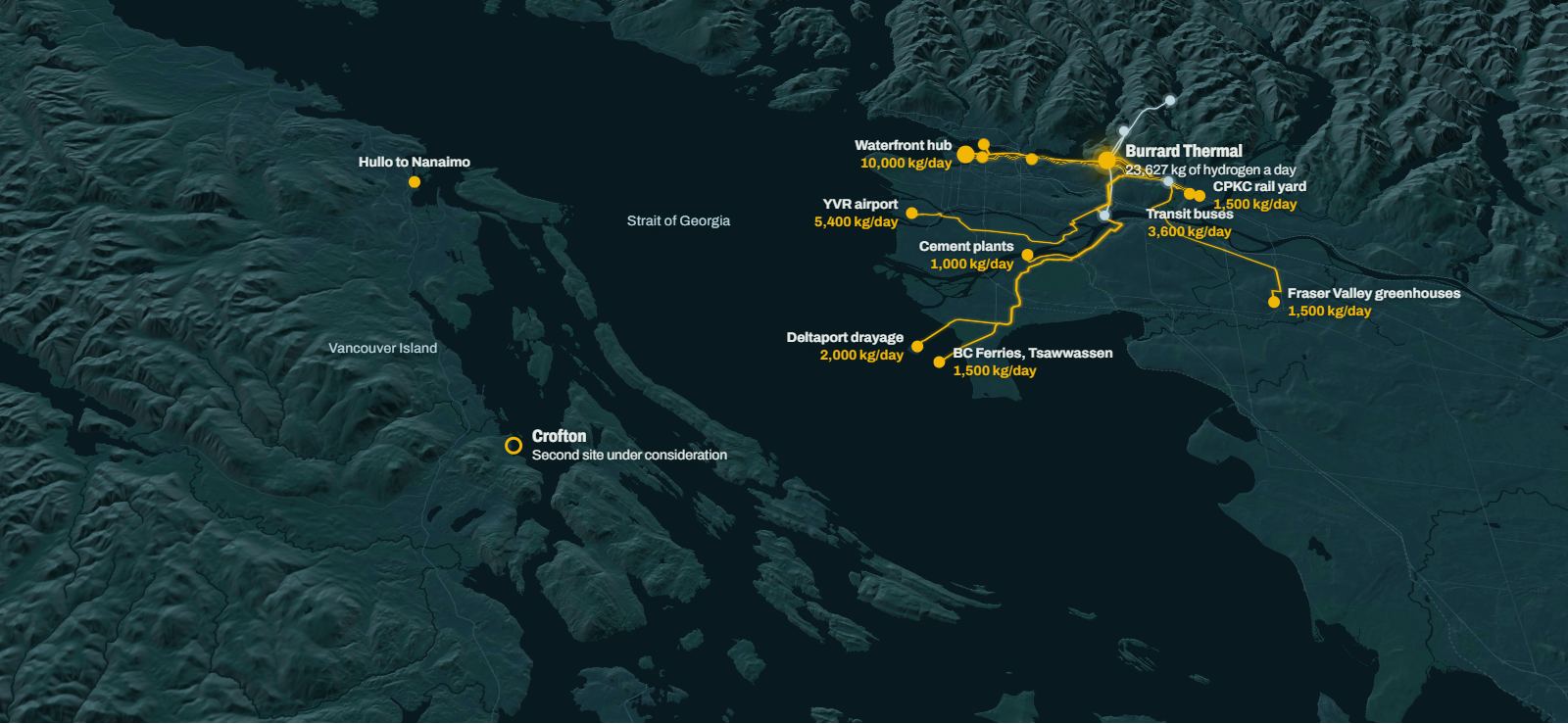
One plant on the old Burrard Thermal power station site can supply the whole harbour.
Routes and supply lines are indicative. Customer volumes are identified demand, not signed contracts.
Customers
Ships, trucks, trains, port cranes and industry around the harbour.
Economics
PDEC runs at an operating profit and creates value for BC in cleaner air and lower emissions.
Partners
Suppliers, possible customers, universities and First Nations PDEC is in conversation with. No contracts are signed yet.
Possible customers
- Hullo
- BC Ferries
- Harbour Air
- Seaspan
- CPKC
- YVR
- Teck Highland Valley Copper
Technology
- Ekona Power
- Ballard Power Systems
- HTEC
- Corvus Energy
- Greenlight Innovation
Energy and port
- BC Hydro
- FortisBC
- Vancouver Fraser Port Authority
- NorthX Climate Tech
Universities
- University of Victoria
- Simon Fraser University
- University of British Columbia
- BCIT
PDEC is also working with First Nations whose territories include both sites, on ownership and benefits from the start.
Plan
Four phases, from site agreements now to a full build by 2032.
Team
A project manager who has delivered hydrogen equipment at the Port of Vancouver, with advisors in Indigenous engagement, finance, people and communications.

Vincent Royer, PMP
Project champion and director
MBA candidate, Sustainable Innovation, UVic Gustavson

Dr. Matt Murphy
Indigenous engagement and academic advisory lead
Professor, Sustainability and Strategy, UVic Gustavson

Olenka Stepanova, CPHR, MBA
People and organizational strategy
Principal consultant, Novaworks

Robin Shelley
Communications and marketing strategy
Fractional CMO, Envisionize

Rhonda Webster
Financial and operational strategy
MBA candidate, UVic Gustavson
Open roles: chief engineer, regulatory lead, and commercial and offtake lead. Express interest
Latest
- Ekona Power, whose process for splitting natural gas into hydrogen and solid carbon PDEC plans to use, completed an early engineering design study for commercial hydrogen and carbon production.
- Canada selected the TKMS Type 212CD, a hydrogen fuel cell submarine, for up to 12 boats. A Pacific fleet will need a secure hydrogen supply.
- The Clean Hydrogen Investment Tax Credit became law. It returns up to 40% of eligible equipment cost.
- BC Hydro set Burrard Thermal's decommissioning to begin in fall 2028, which opens the window for a site lease.
What PDEC needs next
Four contracts turn the model into commitments before anything is built. Together they take operating profit to $30.4M a year. Each figure below is what that contract adds to operating profit a year in PDEC's model, compared with going without it. If you could sign one of them, or help find who will, a short call is the next step.
- +$6.0M
Customer contracts
Fleet, marine, port and industrial hydrogen buyers. They commit to buy a set volume at $6.50/kg, and the price never drops below $5.20/kg. Without contracts the model assumes $5.80/kg.
- +$3.7M
Carbon buyer
Makers of steel, batteries, tires and building materials. They buy the solid carbon left when the plant splits natural gas, at $1,000 a tonne or better.
- +$2.4M
Off-peak power
BC Hydro. A supply agreement at about 5.5 cents a kilowatt-hour, against a published rate of about 6.5 cents, with the plant running when power is cheapest.
- +$0.7M
Anchor volumes
Transit, ferry and port operators. Committed volumes that keep the plant running at 85% of capacity.